
Sliding vs Hinged Shower Doors: Full Comparison Guide
If you’re renovating your bathroom and can’t decide between sliding and hinged shower doors, you’re not alone. It’s one of the most common questions we hear from homeowners across Massachusetts — and the answer isn’t always obvious. Both styles are beautiful, durable, and functional. But the right choice comes down to your bathroom’s layout, your lifestyle, and the look you’re going for.
This guide breaks down everything you need to know about sliding vs hinged shower doors so you can make the best decision for your space.
What Are Sliding Shower Doors?
Sliding shower doors — sometimes called bypass doors — feature two or more glass panels that glide horizontally along a track. To enter the shower, you push one panel in front of the other, creating an opening on one side.
They’ve been a staple of American bathrooms for decades, and modern versions have come a long way. Today’s sliding doors are available in frameless and semi-frameless styles, with premium hardware and thick tempered glass that looks anything but dated.
How Sliding Doors Work
In a standard two-panel sliding configuration, each panel covers roughly half the shower opening. When you slide one panel over, you access about half the total width as your entry point. Some designs include three panels for wider shower enclosures, which allows for a larger opening.
The panels run along a top-mounted track, and in most cases, a bottom track as well. The quality of the rollers and track hardware has a significant impact on how smoothly the door operates over time — which is why professional installation and quality components matter.
What Are Hinged Shower Doors?
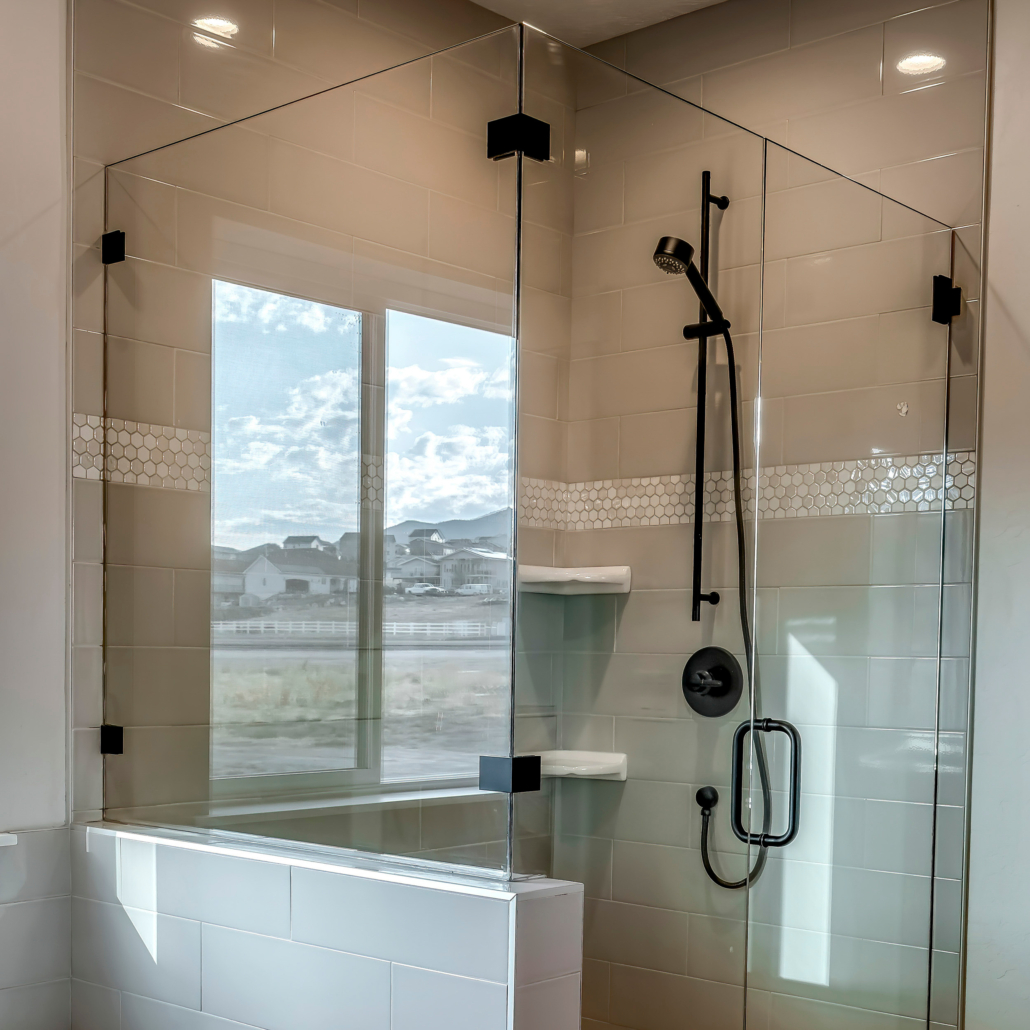
Hinged shower doors swing open on a set of hinges, much like a standard interior door. They’re the go-to choice for frameless shower enclosures and are widely considered the most elegant option for high-end bathroom designs.
The hinges can be mounted to the wall, to a fixed glass panel, or directly to the shower curb or tile — depending on the layout of your shower.
How Hinged Doors Work
A hinged shower door swings either inward, outward, or both (pivot-style), depending on the hinge type. Because the door swings on a fixed point, it opens to the full width of the panel — making entry and exit easy and accessible.
The tradeoff is clearance. A hinged door needs open floor space to swing into. For an outward-swinging door, that typically means 18 to 24 inches of clear space in front of the shower. This is a non-issue in a spacious bathroom, but it can be a real constraint in a smaller one.
Sliding vs Hinged Shower Doors: The Key Differences
1. Space Requirements
This is often the deciding factor — especially in Massachusetts homes where bathrooms in older builds tend to run smaller.
Sliding doors don’t require any swing clearance. The panels move parallel to the wall, so all you need is enough room for the shower enclosure itself. This makes them an excellent fit for tighter bathrooms, condos, and spaces where every square foot counts.
Hinged doors require open floor space for the door to swing. If your toilet, vanity, or wall is positioned close to the shower, a hinged door may not be practical — or safe. That said, in a well-proportioned bathroom, a hinged door creates a wide, unobstructed entry that feels luxurious.
Bottom line: Small or awkward bathroom? Go sliding. Spacious layout with room to swing? Hinged is worth considering.
2. Opening Width and Accessibility
Sliding doors typically offer an entry point that’s about half the total door width. In a 60-inch shower, for example, you’d have roughly 28–30 inches of opening. That’s comfortable for most people, though it can feel tight for those with mobility considerations.
Hinged doors open to the full width of the door panel. In that same 60-inch shower, a hinged door might give you 22–28 inches of clear entry — but it swings completely open rather than partially. This makes hinged doors a stronger option for ADA compliance and accessibility-focused designs.
Bottom line: If accessibility is a priority, hinged doors have the edge due to the wide, unobstructed entry.
3. Glass Thickness and Durability
Both door styles use tempered safety glass — the same type required by building code for shower enclosures. Tempered glass is engineered to shatter into small, blunt pieces rather than dangerous shards if it ever breaks.
Sliding doors are commonly installed with 3/8-inch glass. This provides a solid, quality feel and handles the weight of daily sliding without issue.
Hinged doors are often installed with 3/8-inch or 1/2-inch glass. The thicker option is popular for frameless hinged designs because the glass itself carries more of the structural load — there’s no frame to help support it. Half-inch glass has a noticeably premium look and feel that many homeowners love.
Bottom line: Both are safe and durable. If you want that ultra-substantial, luxury feel, 1/2-inch glass on a frameless hinged door is hard to beat.
4. Frameless vs Framed Options
Sliding doors are most commonly available in semi-frameless styles — meaning the outer frame exists, but the interior panels are unframed. Fully frameless sliding doors exist but are less common, as the track system inherently adds some hardware.
Hinged doors are the dominant choice for fully frameless shower enclosures. Because the door hangs on hinges rather than running along a track, there’s no frame required at all. The result is a seamless, all-glass look that’s widely regarded as the most modern and upscale option on the market.
Bottom line: If a true frameless look is your goal, hinged doors are the way to go.
5. Cleaning and Maintenance
Sliding doors have one maintenance consideration that hinged doors don’t: the track. The bottom track (if present) collects water, soap scum, and mildew over time. Regular cleaning with a brush keeps it clear, but it does require consistent attention. Top-track-only designs reduce this issue significantly.
Hinged doors are generally easier to maintain. Fewer crevices mean fewer places for buildup to hide. The hinges themselves should be wiped down periodically, and glass — regardless of door type — benefits from a squeegee after each use and a regular glass cleaner treatment.
Bottom line: Hinged doors are slightly easier to keep clean. Sliding doors require track maintenance, but it’s manageable with a simple routine.
6. Aesthetics and Style
This one is genuinely subjective, but worth discussing.
Sliding doors have a clean, low-profile look. Modern semi-frameless designs in brushed nickel, matte black, or chrome are polished and contemporary. They suit transitional and modern bathroom styles well.
Hinged doors — especially frameless versions — have a dramatic, open quality that many homeowners find striking. The minimal hardware, thick glass, and uninterrupted lines give them a spa-like quality that’s hard to replicate with a sliding door.
Bottom line: Both look great in the right bathroom. Hinged frameless doors tend to photograph better and have a higher-end feel, which is part of why they’ve become the default choice for luxury bath renovations.
7. Cost Considerations
Both sliding and hinged shower doors vary widely in price depending on glass type, hardware finish, size, and whether they’re custom-fabricated.
Sliding doors tend to be slightly more predictable in cost. The track hardware is generally less expensive than a full set of premium hinges, and semi-frameless options are widely available at accessible price points.
Hinged doors can range from moderate to high depending on the glass thickness and hinge quality. Fully frameless hinged doors with 1/2-inch glass and premium hardware represent the top of the market — and they’re priced accordingly.
Neither option is universally cheaper. The best way to understand your actual cost is to get a custom quote based on your specific shower dimensions and finish preferences.
Which Is Right for Your Bathroom?
Here’s a simple way to think through the decision:
Choose sliding shower doors if:
- Your bathroom is on the smaller side
- You have limited clearance in front of the shower
- You’re working with a tub-shower combination
- Budget is a primary consideration
- You want a clean, low-maintenance track-style door
Choose hinged shower doors if:
- You have a dedicated walk-in shower with room to swing
- You want a fully frameless, all-glass look
- You’re designing a spa-style or luxury master bath
- Accessibility and wide entry matter to you
- You prefer minimal hardware and easier cleaning
What About Pivot Doors?
You may have also heard the term “pivot shower door.” A pivot door is technically a type of hinged door — it rotates on a top and bottom pivot point rather than side-mounted hinges. The result is a door that can swing both inward and outward, which adds flexibility in tight layouts.
Pivot doors are a popular choice in frameless shower design and offer many of the same benefits as standard hinged doors. They’re worth discussing with your installer if you love the frameless look but are working with a layout that makes a standard hinged swing tricky.
Professional Installation Makes All the Difference
Regardless of which door style you choose, the quality of your installation has a direct impact on how your doors perform, seal, and hold up over time.
Improperly installed sliding doors develop alignment issues, sticky tracks, and leaks. Hinged doors that aren’t perfectly level will swing open or closed on their own — and put uneven stress on the glass and hardware. Both problems are avoidable with experienced installation.
At Luxe Glass, every shower door we install is custom-measured and set to precise tolerances. We work with homeowners throughout the greater Boston area — including Newton, Wellesley, Waltham, Cambridge, and Winchester — to design and install shower enclosures that perform beautifully for years.
Sliding or Hinged: Here’s Where We Land
Sliding and hinged shower doors each have a strong case. Sliding doors win on space efficiency and practicality — they’re the smart move for smaller bathrooms, condos, and tub-shower combos where swing clearance just isn’t there. Hinged doors win on aesthetics and simplicity — especially in a frameless configuration, they deliver that clean, uninterrupted glass look that makes a bathroom feel like a genuine retreat.
The honest answer is that most homeowners who see both options installed in person gravitate pretty quickly toward one or the other. It usually comes down to your layout first, your style second.
If you’re still on the fence, the best next step is a conversation with someone who can look at your actual space. Luxe Glass offers free consultations throughout the greater Boston area — we’ll assess your bathroom, talk through your options, and give you a clear recommendation with no pressure attached.