Custom vs Prefab Shower Doors: What’s the Difference?
If you’re shopping for a new shower door, you’ll quickly run into two very different paths: prefab (prefabricated) doors you can buy off the shelf, and custom doors built specifically for your bathroom. They might look similar in a photo, but the experience of owning one versus the other is genuinely different — and the choice has a bigger impact on your bathroom than most people expect going in.
This guide breaks down exactly what separates custom vs prefab shower doors, where each one makes sense, and what to actually expect from both in terms of cost, fit, and long-term value.
What Is a Prefab Shower Door?
Prefab shower doors are manufactured in bulk to standard, fixed dimensions — typically widths like 24″, 28″, 30″, 32″, 34″, and 36″. They’re designed to fit a range of common shower openings approximately, and they’re sold ready to install at home improvement retailers, online marketplaces, and big box stores.
Because they’re mass-produced, prefab doors are made to general specifications rather than your specific bathroom. The manufacturer doesn’t know your exact opening, your wall conditions, or your tile thickness — the door is built to work “close enough” across thousands of different bathrooms.
To make a prefab door fit a real-world opening, installation typically involves trim pieces, spacers, or adjustable tracks that take up the slack between the door’s fixed dimensions and your actual shower opening.
What Is a Custom Shower Door?
A custom shower door is fabricated specifically for one bathroom: yours. The process starts with a precise, in-person measurement of your exact shower opening — including any irregularities, out-of-level walls, or non-standard angles. The glass is then cut, tempered, and finished to those exact dimensions, and the hardware is selected and prepared specifically for that installation.
There’s no fixed sizing, no trim pieces bridging a gap, and no adjustable track compensating for a mismatch. The door is built once, for one opening, to fit that opening precisely.
This is also why custom doors are almost always installed by a professional. The precision that makes a custom door look and perform so well also means it has to be installed by someone who measured it and understands exactly how it was built.
Custom vs Prefab: The Real Differences
1. Fit and Sizing
This is the single biggest difference between the two options.
Prefab doors come in standard widths and need your shower opening to be close to one of those fixed sizes. If your opening falls between standard sizes — which is common, especially in older homes — you’ll either need to modify the opening itself or accept a less-than-perfect fit with visible gaps, spacers, or trim pieces filling the difference.
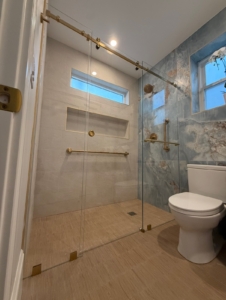
Custom doors are built to your exact opening, whatever that happens to be. Older homes with walls that have shifted slightly over decades, non-standard tile thickness, or unusual angles are not a problem — the measurement accounts for all of it before the glass is ever cut.
What this means in practice: A prefab door in an opening that doesn’t quite match its standard size often shows it — visible gaps, mismatched trim, or a track system doing more visual work than you’d like. A custom door simply fits, cleanly and precisely, the first time.
2. Glass Quality and Thickness
Prefab doors typically use thinner glass — often 1/4-inch — to keep manufacturing costs and shipping weight down. Some better prefab options offer 3/8-inch glass, but the selection is usually limited to whatever the manufacturer has decided to produce at scale.
Custom doors are typically available in 3/8-inch or 1/2-inch tempered glass, and you choose the thickness based on your design goals and the specific door style. Thicker glass has a more substantial feel and is often required for frameless configurations where the glass itself bears more of the structural load.
What this means in practice: A custom door, especially in 1/2-inch glass, has a noticeably more premium feel — both visually and the moment you touch the door. Prefab glass tends to feel lighter and less substantial, which can be especially noticeable in frameless or semi-frameless prefab options.
3. Frame and Hardware Style
Prefab doors are most commonly framed or semi-framed. The frame itself is part of how the door achieves its “close enough” fit — the metal track and border system is engineered to flex slightly to accommodate openings that vary from the exact standard size. Fully frameless prefab options exist but are less common and less reliable for an exact fit.
Custom doors offer the full range of styles — framed, semi-frameless, and fully frameless — because the fit doesn’t depend on a frame compensating for sizing gaps. Frameless and semi-frameless custom doors are particularly popular because the precision fit is what makes the minimal-hardware look actually work.
What this means in practice: If a true frameless look is your goal, custom is really the only reliable path to get there well. Frameless requires precision, and precision is exactly what prefab manufacturing isn’t built for.
4. Hardware Finish Options
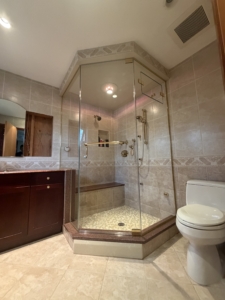
Prefab doors generally come with limited hardware finish choices — often just one or two options, like chrome or brushed nickel, with the specific door model.
Custom doors offer a much wider range of hardware finishes — matte black, brushed gold, polished chrome, brushed nickel — selected independently of the glass and sized appropriately for your specific door configuration.
What this means in practice: If hardware finish matters to your bathroom’s overall design — and for most renovations, it does — custom doors give you the flexibility to actually coordinate with your other fixtures rather than working around whatever finish came with the prefab unit.
5. Installation
Prefab doors are sometimes marketed as DIY-friendly, and simpler models can be installed by a confident homeowner with the right tools. That said, getting a prefab door to actually seal and operate properly — especially when the opening doesn’t perfectly match the door’s standard size — often requires more skill and patience than the packaging suggests.
Custom doors require professional installation. The precision that defines a custom door only delivers its full benefit when it’s installed by someone experienced with that level of precision work — correct leveling, correct hardware placement, correct sealing.
What this means in practice: Prefab gives you the option to DIY, with mixed results depending on your skill level and your opening’s actual dimensions. Custom requires hiring a professional, but the result is a door that performs exactly as designed from day one.
6. Cost
Prefab doors have a clear cost advantage upfront. Standard sizing and mass production keep manufacturing costs down, and many models are available at price points well below custom options.
Custom doors cost more — both for the glass and fabrication itself and for professional installation. The investment reflects the precision measurement, custom fabrication, premium glass options, and skilled installation involved.
What this means in practice: Prefab is the lower-cost option in the short term. Custom costs more upfront but tends to deliver a better long-term result — a better fit, often a longer lifespan, and a finished look that doesn’t read as a budget compromise.
7. Longevity and Long-Term Value
Prefab doors, particularly those installed with a less-than-perfect fit, can develop issues over time — gaps that let water through, tracks that don’t roll as smoothly because they’re compensating for a sizing mismatch, or seals that fail prematurely because they were never quite right to begin with.
Custom doors, installed correctly, are built for the long haul. The precise fit means less stress on hardware and seals over time, and quality glass and commercial-grade hardware are engineered to perform well for decades.
What this means in practice: A prefab door might need replacement or significant repair well before a custom door would. When you factor in the full lifespan of each option, the cost gap between custom and prefab narrows considerably — and in some cases, custom ends up being the better value over time.
8. Aesthetics and Resale Impact
Prefab doors can look perfectly fine — many models are attractive and functional. But the limitations in fit, frame style, and hardware options mean prefab doors rarely achieve the seamless, high-end look that defines premium bathroom design.
Custom doors, particularly frameless and semi-frameless configurations, are widely recognized — by homeowners and buyers alike — as a signal of quality. It’s a detail that consistently shows up in what buyers notice and remember about a renovated bathroom.
What this means in practice: If you’re renovating with resale in mind, or simply want your bathroom to feel like a deliberate, high-end space rather than an assembled-from-parts one, custom is the stronger choice.
When Custom Makes Sense
Custom shower doors are the stronger choice when:
- Your shower opening doesn’t match standard prefab sizing — common in older homes
- You want a frameless or semi-frameless look that actually performs well
- You’re renovating a primary residence where long-term quality matters
- You want hardware finish options that coordinate with the rest of your bathroom
- You’re renovating with resale value in mind
- You want a door that’s installed once and performs correctly from day one
The Real Tradeoff of Custom vs Prefab Shower Doors
Prefab and custom shower doors solve the same basic problem in very different ways. Prefab offers convenience and a lower upfront cost, with real tradeoffs in fit, glass quality, and long-term performance. Custom costs more initially but delivers a precise fit, premium materials, and a finished look that holds up — both functionally and aesthetically — for decades.
For most homeowners investing in a real bathroom renovation, the gap between the two options is worth the cost difference. A shower door is one of the most visible, most-used elements in the entire bathroom — it’s worth getting right the first time.
Finding the Right Fit for Your Bathroom
At Luxe Glass, every shower door we install is custom-measured and fabricated specifically for the bathroom it’s going into. We work with homeowners throughout greater Boston — including Newton, Wellesley, Waltham, Cambridge, Boston, and Winchester — to design and install shower doors that fit precisely and look exceptional for years to come.
If you’re weighing custom against prefab for your own renovation — especially if you’re renovating with resale value in mind — reach out for a free consultation. We’ll take a look at your space and give you an honest read on what makes sense for your specific situation and budget.