
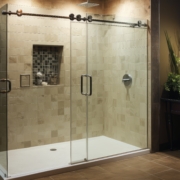
Frameless Shower Doors in Boston, MA
Frameless shower doors in Boston, MA are one of the most requested upgrades we see across the city — and it’s not hard to understand why. Boston bathrooms come in every shape and size, from compact condos in the Back Bay to spacious master baths in Brookline and South End brownstones. The right frameless shower door doesn’t just look beautiful — it works with the space you actually have.
At Luxe Glass, we’ve installed custom frameless shower enclosures across Boston and the surrounding neighborhoods. Every project is different, and that’s exactly the point. This guide is built around what Boston homeowners and condo owners specifically need to know before making a decision.
Boston Bathrooms Are Different — Here’s Why That Matters
Renovating a bathroom in Boston isn’t the same as renovating one in a suburban single-family home. The city’s housing stock is unique — a mix of Victorian brownstones, converted multi-families, newer high-rise condos, and everything in between. That variety creates a set of considerations that don’t always come up in general shower door guides.
Space tends to be tighter. Boston bathrooms — particularly in older buildings and converted units — frequently run small. In a city where square footage is at a premium, every design decision needs to account for the actual footprint available. The wrong door style in a tight bathroom doesn’t just look off — it makes the room harder to use every single day.
Building and condo rules apply. Many Boston condo associations and historic buildings have renovation guidelines — approved contractors, permitting requirements, noise restrictions, and rules about structural changes. It’s worth reviewing your building’s requirements before starting any bathroom project.
The resale market is competitive. Boston’s real estate market rewards well-finished bathrooms. Buyers in this city are experienced and discerning — they notice details, and a frameless shower door is consistently one of the details that makes a lasting impression.
Installation logistics are real. Working in a Boston building means elevator scheduling, protecting common areas, parking coordination, and being respectful of neighbors. An installer who’s done city work before handles all of this as a matter of course.
What Are Frameless Shower Doors?
Frameless shower doors are tempered glass enclosures with no surrounding metal frame. The glass panels are held in place by precision hardware — hinges, clips, and wall-mounted brackets — rather than a bulky aluminum border.
The practical result is a shower that feels open and visually connected to the rest of the bathroom. There’s no frame interrupting the sight line, no aluminum channel collecting moisture and soap scum, and no visual cue that the shower is a separate box inside the room. Just clean glass, quality hardware, and the tile work behind it.
In a Boston bathroom — where making a small space feel as open and finished as possible is often the primary goal — that openness matters more than almost anywhere else.
The Best Frameless Shower Door Styles for Boston Homes
Sliding Frameless Doors — The Space-Smart Choice for the City
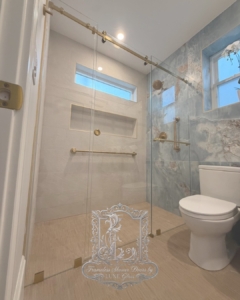
For Boston’s compact bathrooms and condo spaces, sliding frameless doors are often the most practical option — and in their modern configurations, they’re also genuinely beautiful.
Sliding doors move horizontally along a track, so there’s no swing clearance required at all. The entire footprint of the door stays within the shower enclosure. In a bathroom where the toilet or vanity is positioned close to the shower, this is often the deciding factor.
Today’s sliding doors have moved well past the heavy framed look of older bypass doors. Slim track profiles, thick tempered glass panels, and premium hardware finishes give modern sliding doors a clean, upscale appearance that works in any Boston bathroom style.
Best for: Compact bathrooms, tub-shower combinations, older Boston brownstones and converted units where space is limited.
Hinged Frameless Doors — The Premium Choice When Space Allows
When the bathroom layout provides adequate swing clearance — typically 18 to 24 inches in front of the shower — a frameless hinged door is the single most impactful upgrade you can make.
The all-glass look with minimal hardware creates a sense of openness that’s immediately striking. No frame, no track, no visual interruption — just the shower and the space around it feeling like one connected room. In a well-proportioned Boston bathroom, a frameless hinged door is the detail that makes the whole renovation feel complete.
Best for: Dedicated walk-in showers with adequate clearance, South End and Back Bay condos with more generous layouts, master baths in larger Boston homes.
Pivot Frameless Doors — Flexible for Tricky Layouts
Boston buildings have character — and sometimes that means non-standard bathroom geometries. Pivot doors rotate on top and bottom pivot points and can swing both inward and outward, which adds flexibility in layouts where a standard hinged door’s swing direction would be blocked.
If an outward swing hits the vanity or toilet but an inward swing is workable — or vice versa — a pivot door opens up options that a standard hinged door wouldn’t. It’s a frameless, minimal-hardware solution that suits Boston’s often-irregular bathroom layouts particularly well.
Best for: Boston bathrooms with dedicated showers where swing direction is constrained, newer Seaport and South Boston condos with modern layouts.
Fixed Panel Enclosures — For Open Walk-In Designs
Some of Boston’s newer condo developments — particularly in the Seaport, Midtown, and South Boston — feature open walk-in showers with no curb and no door. A fixed frameless glass panel provides water containment while keeping the shower visually open and connected to the bathroom.
This is a bold, spa-inspired choice that works best in larger shower enclosures and more contemporary design schemes. It photographs beautifully and has a genuinely luxury feel in person.
Best for: Open walk-in showers in newer Boston construction, contemporary and minimalist bathroom designs.
Glass Options for Boston Bathrooms
Thickness
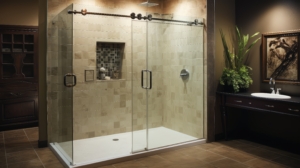
Most Boston bathroom installations use 3/8-inch tempered glass as the standard, with 1/2-inch available for frameless hinged and pivot configurations where the glass carries more structural load. The thicker option has a noticeably more premium feel and is increasingly popular in higher-end Boston renovations.
Clear vs Privacy Glass
Clear glass is the right call for most Boston bathrooms — it maximizes the sense of space and keeps smaller rooms feeling open and bright. In a city where bathroom square footage is often limited, anything that adds visual depth is valuable.
Frosted and textured glass makes sense in specific situations — a shared bathroom in a condo, a layout where the shower is partially visible from a living area, or a bathroom with windows that create privacy concerns. Reeded glass, with its subtle vertical texture, has become a popular choice in 2026 for homeowners who want privacy glass that also functions as a design element.
Low-Iron Glass
Standard clear glass has a slight green tint that becomes more visible in larger panels. Low-iron glass eliminates that tint, producing a cleaner, more transparent appearance. It’s a worthwhile upgrade in Boston bathrooms where the tile work is a focal point — particularly in larger shower enclosures where the difference is most visible.
Protective Coatings
In a high-use city bathroom, a professional water repellent coating on the glass is a particularly smart investment. It causes water to bead and roll off rather than sitting and building up mineral deposits — dramatically reducing cleaning time and keeping the glass looking sharp for longer.
Hardware Finishes for Boston Bathrooms
The hardware finish you choose should coordinate with your existing or planned bathroom fixtures for a cohesive, finished look. What’s popular in Boston right now:
Matte black — the dominant finish in Boston’s newer condos and renovated units. Works especially well against white subway tile, light grey, and minimal design schemes — all common in Boston bathrooms.
Brushed nickel — warm and versatile, works across traditional and contemporary styles. A reliable choice for Boston’s older brownstones and Victorian-era homes where the overall aesthetic leans more classic.
Polished chrome — bright, timeless, and light-reflecting. Suits minimalist and contemporary interiors well.
Brushed gold — gaining traction in Boston’s higher-end renovations, particularly in the Back Bay, Beacon Hill, and South End where bathrooms tend toward a more luxurious finish level.
Working in Boston Buildings — What to Expect
Condo and multi-unit building installations require coordination that single-family home projects don’t. At Luxe Glass, we’ve done enough Boston work to handle all of it smoothly:
Elevator and access scheduling — we coordinate building access in advance so installation day runs without disruption to other residents.
Common area protection — floors, walls, and elevator interiors are protected throughout the project.
Building compliance — we’re familiar with the renovation requirements common to Boston condo associations and work within them as standard practice.
Efficient installation — most Boston shower door installations are completed in a single visit. We work cleanly, efficiently, and with full respect for the building and its residents.
Serving Boston and Surrounding Neighborhoods
Luxe Glass works with homeowners and condo owners throughout Boston — including the South End, Back Bay, Beacon Hill, Charlestown, Seaport, South Boston, East Boston, and Midtown — as well as surrounding communities including Brookline, Cambridge, Somerville, and Newton. We know the city’s housing stock, its buildings, and its bathrooms, and we bring that knowledge to every project.
Finding the Right Fit for Your Boston Bathroom
Boston bathrooms reward smart design decisions — and a frameless shower door is one of the clearest examples of an upgrade where the return, both in daily enjoyment and in resale value, consistently exceeds the investment.
The right door for your specific bathroom depends on your layout, your building, and your goals. If you’re not sure where to start, a conversation with someone who knows Boston bathrooms is the fastest path to clarity. Reach out to Luxe Glass for a free consultation — we’ll assess your space and give you a straightforward recommendation with no pressure attached.